Call us today!

PP Biaxial Geogrid VS Triaxial Geogrid
PP Biaxial Geogrid: Best for stabilizing soft subgrades and reinforcing layered systems where the primary forces are in two, perpendicular directions (e.g., roads, foundations, retaining walls). It acts like a stiff,high-tensile reinforcement.
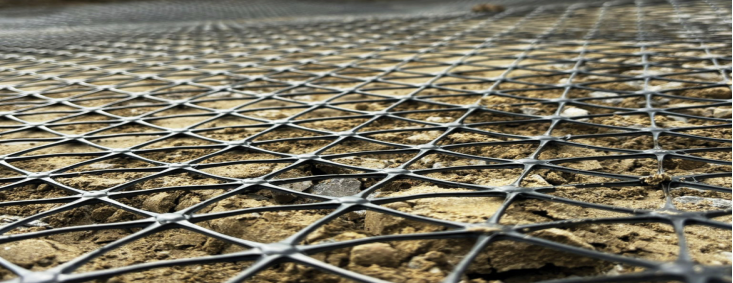
Triaxial Geogrid: Best for base course reinforcement over stable subgrades, especially where loads are multi-directional. It excels at confinement and interlock within granular aggregates, distributing loads more efficiently. It is the modern standard for paved and unpaved roads.
Difference of PP Biaxial Geogrid and Traxial Geogrid
| Product Name | PP Biaxial Geogrid | Triaxial Geogrid |
| Material & Structure | Polypropylene (PP). Punched sheet, drawn into a rectangular aperture grid. | Typically Polypropylene (PP) or Polyethylene (PE). Punched sheet, drawn and oriented into a stable, triangular aperture grid. |
| Aperture Shape | Rectangular or Square. | Triangular (Hexagonal). |
| Mechanical Action | Tensile Reinforcement & Separation. Provides high tensile stiffness in two main directions (machine & cross-machine). | Multi-directional Confinement & Interlock. Provides stiffness in multiple directions, offering superior radial stiffness. |
| Primary Function | Carries tensile loads to reduce deformation and improve overall stability. | Improves the performance of the aggregate layer itself by mechanically stabilizing it through confinement. |
| Key Property | High Tensile Modulus at low strain (e.g., 2% strain). | In-plane Stiffness and Aggregate Interlock. |
| Load Distribution | Good in two primary directions. | Excellent and uniform in all directions. More efficient at distributing loads, reducing vertical stress on the subgrade. |
| Applications | •Soil Reinforcement for Retaining Walls & Steep Slopes • Foundations over soft soil • Subgrade Stabilization | •Base Reinforcement for Paved & Unpaved Roads •Railway Ballast •Working platforms over stable subgrade •Applications with multi-directional traffic (e.g., parking lots, intermodal yards) |
| Advantages | •High tensile strength in primary directions. •Excellent for long-term reinforcement under constant load. •Cost-effective for its target applications. | • Reduces rutting more effectively. • Allows for reduced aggregate thickness. • Performs better under dynamic/cyclic loading. • Excellent resistance to installation damage. |
In-Depth Explanation
1. PP Biaxial Geogrid
•How It Works: The manufacturing process (punching and drawing) aligns the polymer molecules, creating a very stiff grid with high tensile strength in its two primary directions. When placed between two layers (e.g., between soft subgrade and a gravel base), it:
1.Separates the layers, preventing the intermixing of soils.
2.Resists Tensile Forces. As the soft soil beneath tries to deform, it induces tensile strain in the geogrid. The geogrid’s high stiffness resists this strain, spreading the load over a wider area via “membrane support.”
2. Triaxial Geogrid
•How It Works: The key is the triangular aperture geometry. This shape is inherently more stable and provides radial stiffness (stiffness in all directions in the plane of the grid. Its primary mechanism is confinement:
1.Mechanical Interlock: The angular aggregate particles partially penetrate the apertures and lock into place.
2.Confinement: The geogrid’s ribs prevent the aggregate particles from moving laterally when a load is applied. This confinement dramatically improves the bearing capacity of the aggregate layer itself, turning it into a “mechanically stabilized layer.”
3.Improved Load Distribution: The multi-directional stiffness distributes wheel loads through a wider angle, reducing the pressure reaching the weak subgrade.
Conclusion:
The choice is not about which product is “better” in an absolute sense, but which one is more effective for the specific engineering mechanism you require.
•For tensile reinforcement against global instability (walls, slopes, very soft ground), choose PP Biaxial Geogrid
. •For lateral confinement and stabilization of a granular layer (pavement base, working platforms), choose Triaxial Geogrid.
Keywords:
1. PP Geogrid