Call us today!

What’s Asphalt Fiberglass Grid?
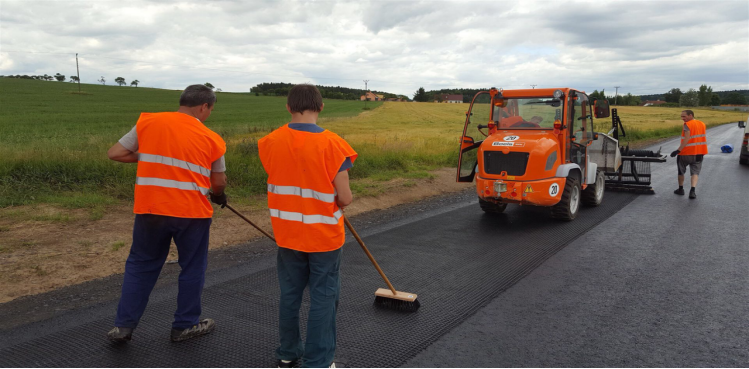
Lianyi®Asphalt Fiberglass Grid is an excellent geosynthetic material used for road surface reinforcement, old road strengthening, and roadbed and soft soil foundation reinforcement.Asphalt Fiberglass geogrid
is a semi-rigid product made of high-strength alkali-free glass fiber yarns through an internationally advanced warp knitting process to form a mesh base material, which is then coated on the surface. It features extremely high tensile strength in both the warp and weft directions and a relatively low elongation rate.Fiberglass geogrid also possesses excellent properties such as heat resistance, cold resistance, anti-aging, and corrosion resistance.Asphalt fiberglass grid is widely used in the reinforcement of asphalt pavements, cement pavements, and roadbeds, as well as in railway roadbeds, embankment slope protection, airport runways, and sand prevention and control projects.
Asphalt fiberglass grid is a kind of mesh structure material made of glass fiber yarns through certain weaving techniques. To protect the glass fiber yarns and improve the overall performance, it undergoes a special coating treatment process to form a geocomposite material.
Asphalt fiberglass grid is made by weaving and coating glass fiber filaments. Asphalt fiberglass grid feature extremely high tensile strength in both longitudinal and transverse directions, low elongation, high elastic modulus, and excellent resistance to high and low temperatures. After surface coating treatment, they possess superior alkali resistance and aging resistance, and are widely used in the reinforcement of asphalt pavements, cement concrete pavements, and roadbeds. It is applicable to both hard and flexible road surfaces. Compared with traditional road surfaces, it can reduce costs, extend service life and prevent reflective cracks on the road. Asphalt fiberglass grid can also be used for reinforcing soft soil in railways, airports, water conservancy projects, DAMS, etc., as well as for reinforcing road bases.
Features Of Asphalt Fiberglass Grid
*The main component of glass fiber is silicon oxide, which is an inorganic material. Its physical and chemical properties are extremely stable, and it features high strength, high modulus, excellent wear resistance, outstanding cold resistance, and no long-term creep. Good thermal stability; The reticular structure interlocks and restricts the aggregates. Enhance the load-bearing capacity of asphalt mixtures. Due to the special modified asphalt coating on the surface, it has dual composite performance, which greatly improves the wear resistance and shear capacity of the fiberglass geogrid .
.
*The product features high strength, low elongation, high temperature resistance, high modulus, light weight, good toughness, corrosion resistance and long service life. It can enhance and strengthen the road surface, prevent rutting and fatigue cracking of the road surface It can resist thermal and cold expansion cracks and reflective cracks beneath, and disperse the load-bearing stress of the road surface, thereby extending the service life of the road surface. It has high tensile strength and low elongation, no long-term creep, good physical and chemical stability, good thermal stability, resistance to fatigue cracking, high-temperature rutting, low-temperature shrinkage cracking, and can delay and reduce reflective cracks.
*Sometimes, in combination with self-adhesive pressure-sensitive adhesive and surface asphalt impregnation treatment, the grid and the asphalt pavement are closely integrated into one. Due to the increased interlocking force of soil and stone materials within the fiberglass geogrid, the friction coefficient between them significantly increases (up to 0.8 to 10). The uplift resistance of the fiberglass geogrid buried in the soil is significantly enhanced due to the strong frictional biting force between the fiberglass geogrid and the soil. Therefore, it is an excellent reinforcing material. Meanwhile, fiberglass geogrid are a kind of lightweight and flexible plastic flat mesh material. They are easy to cut and connect on site and can also be overlapped and lapped. The construction is simple and does not require special construction machinery or professional technicians.
Advantages Of Asphalt Fiberglass Grid
*Slow down reflective cracks
Reflective cracks are caused by significant displacement of the old concrete surface layer near the joints or cracks, resulting in stress concentration within the asphalt overlay above it. They include horizontal displacement due to changes in temperature and humidity, as well as vertical shear displacement caused by traffic loads. The former leads to a relatively concentrated tensile stress within the asphalt overlay above the joint or crack. The latter subjects the asphalt overlay above the joint to greater flexural tensile stress and shear stress.
Due to the high modulus of fiberglass geogrid, reaching 67Gpa, they are applied as hard interlayers with high rigidity in asphalt overlay layers. Their function is to suppress stress, release strain, and at the same time, as reinforcing materials for asphalt concrete, enhance the tensile and shear strength of the overlay structure, thereby achieving the purpose of reducing cracks. Practical experience shows that the corresponding crack energy of a horizontal crack that has changed direction can move 0.6 meters from its starting point. Reinforcing materials with a width of more than 1.5 meters help ensure that the energy is completely dissipated on both sides of the crack.
*Resistance to fatigue cracking
The asphalt overlay on the old cement concrete pavement mainly serves to enhance the pavement’s functionality and makes little contribution to its load-bearing capacity. The rigid concrete pavement beneath the overlay still plays a crucial role in load-bearing. However, the asphalt overlay on the old asphalt concrete pavement is different. The asphalt overlay will bear the load together with the old asphalt concrete pavement. Therefore, when asphalt overlay is applied to asphalt concrete pavement, in addition to reflective cracks, fatigue cracking will also occur due to the long-term action of loads. We conducted a force analysis on the loading conditions of the asphalt overlay on the old asphalt concrete pavement: As the asphalt overlay is a flexible surface layer of the same nature as the asphalt overlay, the road surface will bend and sink when subjected to loads. The asphalt overlay layer in direct contact with the wheel is subjected to pressure, while the surface layer is subjected to tensile force outside the wheel load edge. Due to the different nature of the forces acting on the two force-bearing areas and their close proximity to each other, damage is prone to occur at the junction of the two force-bearing areas, that is, at the sudden change of force. Fatigue cracking occurs under the action of long-term loads.
In the asphalt overlay layer, fiberglass geogrid can disperse the above-mentioned compressive and tensile stresses, forming a buffer zone between the two stressed areas. Here, the stress changes gradually rather than suddenly, reducing the damage to the asphalt overlay layer caused by sudden stress changes. Meanwhile, the low elongation of the fiberglass geogrid
reduces the deflection of the road surface, ensuring that the road surface will not undergo excessive deformation.
*High-temperature resistant rutting
Asphalt concrete exhibits rheological properties at high temperatures, which are specifically manifested as: the surface layer of asphalt roads becomes soft and sticky in summer. Under the action of vehicle loads, depressions occur in the stressed area. After the vehicle loads are removed, the asphalt surface layer cannot fully recover to its pre-load condition, that is, plastic deformation occurs. Under the repeated rolling of vehicles, plastic deformation accumulates continuously, forming ruts. After analyzing the structure of the asphalt surface layer, it can be known that due to the rheological properties of asphalt concrete at high temperatures, and when subjected to loads, there is no mechanism in the surface layer that can restrict the movement of aggregates in the asphalt concrete, the asphalt surface layer is pushed, which is the main reason for the formation of ruts.
The use of fiberglass geogrid in the asphalt overlay layer serves as a framework in the asphalt surface layer. In asphalt concrete, aggregates run through the fiberglass geogrid, forming a composite mechanical interlocking system that restricts the movement of aggregates and increases the lateral restraint force in the asphalt overlay layer. The various parts of the asphalt surface layer check and balance each other, preventing the displacement of the asphalt surface layer and thus playing a role in resisting rutting.
*Resistant to low-temperature shrinkage cracking
In extremely cold regions, the surface temperature of asphalt roads in winter is close to the ambient temperature. Under such temperature conditions, asphalt concrete shrinks when cooled, generating tensile stress. When the tensile stress exceeds the tensile strength of asphalt concrete, cracks occur. Cracks develop in areas where they are concentrated, leading to diseases. From the perspective of the causes of cracks, the key to solving the problem lies in how to make the strength of asphalt concrete resist tensile stress.
The application of fiberglass geogrid in asphalt overlay layers significantly enhances the tensile strength of asphalt concrete, enabling it to withstand considerable tensile stress without failure. In addition, even if cracks occur in a local area, causing the stress at the crack site to be overly concentrated, the stress will gradually disappear through the transmission of the fiberglass geogrid, and the cracks will no longer develop into cracks. When selecting fiberglass geogrid, in addition to their performance indicators meeting the requirements of the above table, special attention should also be paid to ensuring that their width is not less than 1.5m, so as to have sufficient cross-sectional area when they are used as interlayers to control reflective cracks to fully dissipate crack energy. Meanwhile, the mesh size should be 0.5 to 1.0 times the maximum particle size of the asphalt surface layer material on it. This is conducive to achieving the best shear adhesive property and promoting the interlocking and confining of aggregates.