Call us today!

Fiberglass Geogrid VS Polyester Geogrid
Fiberglass Geogrid: Known for its extremely high tensile strength and modulus (stiffness) at a low strain. It is inert to biological and chemical degradation but is susceptible to damage in alkaline environments and has lower resistance to installation damage. Its primary function is reflection crack inhibition in pavement overlays.
Polyester Geogrid: Known for its excellent long-term creep resistance and durability. It has high tensile strength and good flexibility, making it robust during installation. It is primarily used for soil reinforcement in demanding, long-term applications like retaining walls and steep slopes.
Difference of Fiberglass Geogrid and Polyester Geogrid
| Product Name | Fiberglass Geogrid | Polyester Geogrid |
| Material & Composition | Glass fiber filaments yarns coated with a protective polymer (e.g., PVC, acrylic). | Polyester (PET) yarns, typically coated with PVC or another polymer. |
| Chemical Structure | Inorganic, amorphous solid. | Organic polymer with ester functional groups. |
| Primary Characteristic | Very High Tensile Modulus (Extremely Stiff) | Excellent Creep Resistance |
| Tensile Behavior | High strength, low elongation (breaks at 3%-5% strain). Brittle behavior. | High strength, moderate elongation (breaks at 10%-15% strain). Ductile behavior. |
| Durability & Aging | Excellent resistance to acids, chemicals, and biological decay. Vulnerable to alkalis (e.g., cementitious environments). | Good general chemical resistance. Excellent long-term durability in most soil environments. |
| Installation Damage | More susceptible due to the brittleness of the glass fiber filaments yarns. Requires careful backfilling. | Highly resistant due to the flexibility and toughness of the polyester yarns. |
| Long-Term Performance | Strength can degrade over time in high-pH environments. Minimal creep under constant load. | The benchmark for creep resistance. Designed to maintain load for 75-120+ years without significant stretching. |
| Primary Function | Reinforcement & especially Reflection Crack Inhibition. | Soil Reinforcement. |
| Applications | • Asphalt Pavement Overlays (to delay reflection cracks) • Soil stabilization where high stiffness is immediately needed. | • Reinforced Soil Retaining Walls (MSE Walls) • Reinforced Steep Slopes • Base Reinforcement over soft subgrades |
In-Depth Explanation
1. Fiberglass Geogrid
How It Works: The incredible stiffness (high modulus) of fiberglass is its key asset. When placed between an old, cracked pavement and a new asphalt overlay, it absorbs the stress from the movement of the old pavement. It does this not by stretching, but by distributing the stress over a wider area, effectively “bridging” the crack and preventing it from propagating quickly to the surface. This process is called reflection crack inhibition.
•Advantages:
1.High Stiffness: Provides immediate, high tensile resistance with very little deformation.
2.Chemical Inertness: Performs well in acidic environments and is impervious to rot and mildew.
3.Lightweight: Easy to handle and install.
•Disadvantages:
1.Alkali Sensitivity: The Achilles’ heel of fiberglass. The glass fiber filaments yarns can be corroded by the high pH (alkalinity) present in cement-stabilized bases or Portland cement concrete. Special, more expensive coatings are required for these applications.
2.Brittleness: The glass fiber filaments yarns are inherently brittle, making the geogrid more vulnerable to damage during installation if not handled with care (e.g., from sharp rocks or equipment).
3.Creep Concerns: While it exhibits low creep due to its stiffness, its long-term load-bearing capacity in reinforcing soils is less proven than polyester’s.
2. Polyester Geogrid
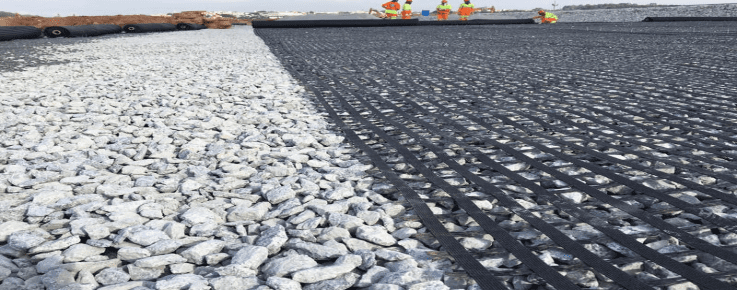
How It Works: Polyester geogrids are the workhorse of Mechanically Stabilized Earth (MSE) structures. Their excellent creep resistance is the most critical property here. When used to reinforce a soil mass (like in a retaining wall), the geogrid must hold the load for the structure’s entire design life (often 75-100 years) without significantly stretching (creeping). Polyester geogrid is uniquely suited for this.
•Advantages:
1.Superior Creep Resistance: This is the single most important reason for choosing polyester for permanent soil reinforcement. It can sustain a high percentage of its ultimate strength for decades.
2.Durability & Toughness: Highly resistant to installation damage and have excellent long-term durability in a wide range of soil environments.
3.Flexibility: Conforms well to uneven subgrades and is easier to handle without fear of brittle fracture.
•Disadvantages:
1.Hydrolysis Risk: Polyester geogrid can degrade through a chemical process called hydrolysis, which is accelerated by high temperatures and high pH (alkaline) environments. However, modern geogrids are manufactured with specially formulated PET polymers and coatings that are highly resistant to hydrolysis, making them suitable for most soil conditions.
2.Lower Initial Stiffness: It is not as stiff as fiberglass and is therefore not the preferred choice for reflection crack control in pavements.
Conclusion:
The choice is driven by the primary function and design life of the structure.
For pavement overlay systems where the goal is to control reflective cracking, Fiberglass Geogrid is the specialized and most effective solution.
For permanent soil reinforcement structures like retaining walls and slopes, Polyester Geogrid is the industry standard due to its unparalleled long-term creep performance and durability.