Call us today!

What’s Geogrid?
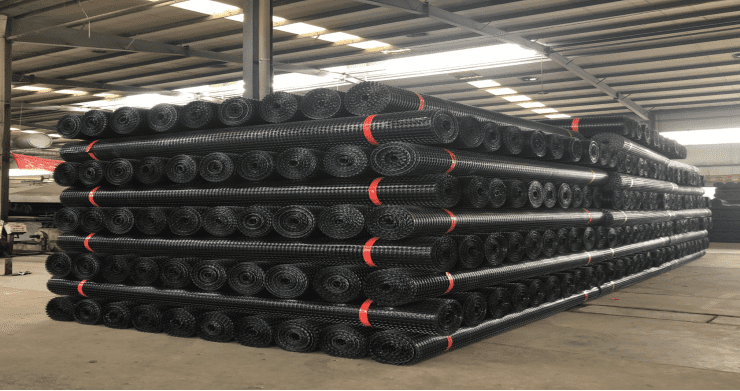
Lianyi®Geogrid is a major type of geosynthetic material.Compared with other geosynthetic materials, it has unique properties and functions.Commonly used as reinforcing materials for reinforced soil structures or composite materials, etc.Geogrids are classified into four major categories:pp geogrid,steel-plastic composite geogrid,pp/pet welded geogrid ,mining geogrid,basalt geogrid,glass fiber geogrid and warp knitted polyester geogrids. Geogrids are two-dimensional grid screens or three-dimensional grid screens with a certain height made of high-molecular polymers such as polypropylene and polyvinyl chloride through thermoplastic or molding processes. When used in civil engineering, they are called geogrid.
(1) PP geogrid
PP geogrids are polymer mesh materials with square or rectangular shapes formed by stretching.According to the different stretching directions during manufacturing, they can be classified into uniaxial stretching and biaxial stretching types. It involves punching holes in polymer sheets produced by extrusion (the raw materials are mostly polypropylene or high-density polyethylene),and then subjecting them to directional stretching under heating conditions.Uniaxial stretched grid is made by stretching only along the length of the plate, while biaxial stretched grid is made by further stretching the uniaxial stretched grid in a direction perpendicular to its length.
Due to the fact that during the manufacturing process of plastic geogrids,the high-molecular polymers of the polymer will be rearranged and oriented along with the heating and stretching process, the connection force between the molecular chains is strengthened, achieving the purpose of enhancing its strength.Its elongation is only 10% to 15% of that of the original sheet.If anti-aging materials such as carbon black are added to geogrid, they can have better durability properties such as acid resistance, alkali resistance, corrosion resistance and anti-aging.
Biaxial geogrids are made from high-molecular polymers through extrusion, plate forming, punching processes, and then stretched longitudinally and laterally.This material has great tensile strength both in the longitudinal and transverse directions. This structure can also provide an ideal interlocking system for more effective force bearing and diffusion in the soil, and is suitable for large-area permanent load-bearing foundations
Uniaxial geogrids are made by extruding high-molecular polymers into thin plates, punching regular hole nets, and then stretching them longitudinally.During this process, the polymer is made into a directional linear state and forms a long elliptical network structure with uniform distribution and high node strength.This structure features a rather high tensile strength and tensile modulus.Particularly, our company’s products of this type have an early tensile strength and tensile modulus that exceed international standards (with elongation ranging from 2% to 5%).It provides the soil with an ideal chain system for bearing and diffusing forces.This product has a high tensile strength (>150Mpa), is suitable for various soils, and is currently widely used as a reinforcing and strengthening material.
Triaxial Geogrid is made from a punched polypropylene sheet oriented in multiple, equilateral directions to form its triangular aperture, resulting in high radial stiffness throughout the full 360 degrees. PP Triaxial Geogrid is a kind of polypropylene bidirectional overall tensile geoglage, the mesh is triangular, each node has 6 ribs, the structure is stable, the force is uniform, and the performance is superior.
(2) Steel-plastic composite geogrid
Steel-plastic composite geogrids are made from high-strength steel wires (or other fibers) that have undergone special treatment, combined with polyethylene (PE) and other additives, and extruded to form composite high-strength tensile strips.If the surface has a rough texture, it is called a high-strength reinforced geogrid.From this single strip, it is woven or interlaced at certain intervals in the longitudinal and transverse directions, and the junction points are welded by a special reinforced bonding fusion welding technology to form a reinforced geogrid.
(3) PP welded geogrid
PP Welded Geogrid is made of polypropylene as the main material, adding anti-aging agents and other auxiliary agents, by extruding and stretching into a high strength fine rib with rough surface embossed, the rib is at right angles to the plane weft, and its intersection is welded by ultrasonic wave.PP Welded Geogrid is modern type of geosynthetic material used for soil reinforcement, ground stabilization, and various civil engineering applications.
(4) Glass fiber geogrid
Glass fiber geogrid is a kind of mesh structure material made of glass fiber through certain weaving techniques.To protect the glass fiber and improve the overall performance, it undergoes a special coating treatment process to form a geocomposite material.The main component of glass fiber is silicon oxide, which is an inorganic material.Its physical and chemical properties are extremely stable, and it features high strength, high modulus, excellent wear resistance, outstanding cold resistance, and no long-term creep.Good thermal stability;the reticular structure interlocks and restricts the aggregates.Enhance the load-bearing capacity of asphalt mixtures.Due to the special modified asphalt coating on the surface, it has dual composite performance, which greatly improves the wear resistance and shear capacity of the geogrid.
- Polyester geogrid
Polyester geogrids are made from high-strength polyester yarns as raw materials. It adopts a warp knitted directional structure. The warp and weft yarns in the fabric have no bending state with each other. The intersection points are bound and combined with high-strength fiber filaments to form a firm connection point, fully exerting its mechanical properties. The high-strength warp knitted polyester geogrid features high tensile strength, low elongation, large tear strength, and small difference in longitudinal and transverse strength. It is resistant to ultraviolet aging, wear and corrosion, lightweight, and has strong interlocking force with soil or crushed stones. It plays a significant role in enhancing the shear resistance of soil and reinforcing to improve the integrity and load-bearing capacity of soil.
(6)Mining Geogrid
Minining geogrid is a kind of plastic protective net used in underground coal mines. It is mainly made of polypropylene and processed by flame-retardant and anti-static technologies. It is formed into an integral structure of “double anti-” plastic geogrid by biaxial stretching. This product is easy to install, has a low cost, is safe and beautiful Mining geogrids are also known as biaxially oriented plastic grid false roofs for underground coal mines in coal mining operations, abbreviated as false roof nets. Mining geogrids are specially designed and manufactured for the false roof support of underground mining faces and the side support of roadways in coal mines. They are made by using several high-molecular polymers and adding other modifiers through processes such as heating, extrusion, molding, punching, stretching, shaping, and winding.Compared with metal textile nets and plastic woven nets,mining geogrid have the characteristics of light weight, high strength, isotropy, anti-static, non-corrosive and flame-retardant. They are a new type of mesh grid material for underground support projects in coal mines and civil engineering.
1. Geogrid
2. PP Geogrid