Call us today!

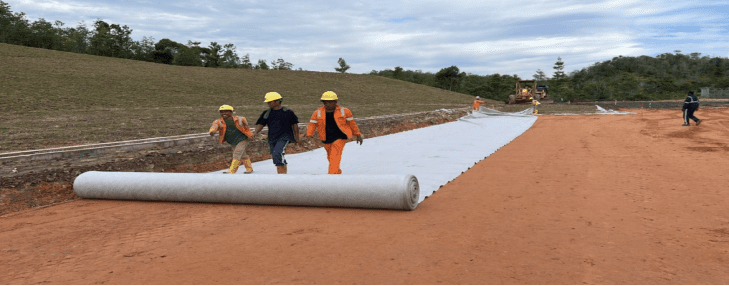
Lianyi®Composite geomembrane is a multifunctional integrated material made by combining geomembrane (anti-seepage layer) and geotextile (protective and drainage layer) through processes such as hot pressing and adhesive bonding. The most common structure is “two geotextile and one geomembrane” or “one geotextile and one geomembrane“.
Features Of Composite Geomembrane
Its characteristics can be summarized as “one body with two wings” :
*Integrated: The geotextile membrane in the middle forms the main anti-seepage body, providing a reliable impermeable barrier.
*Two wings: The geotextile on the upper and lower (or single side) provides two core auxiliary functions:
*Protection: Prevent the geomembrane from being punctured by sharp objects from the base layer and distribute stress.
*Enhanced friction and drainage: Increase the surface roughness to stabilize the slope and allow the gas and a small amount of liquid under the film to be discharged laterally.
Advantages Of Composite Geomembrane
(1)Outstanding comprehensive mechanical properties
*It has extremely strong puncture resistance, tear resistance and puncture resistance: As a buffer layer, geotextile can effectively resist the damage from sharp objects such as crushed stones and tree roots in the base layer.
*High tensile strength: The load is jointly borne by geotextile and geomembrane, significantly enhancing the overall tensile strength and deformation modulus.
(2)Extremely high interface stability
High coefficient of friction: The rough fiber surface of geotextiles can produce a good interlocking effect with soil, sand and stone materials, greatly increasing the frictional resistance between the material and the contact surface. This gives it an irreplaceable advantage in slope and steep slope engineering, effectively preventing slippage.
(3)Excellent construction adaptability and protective functions
*Low requirements for the base layer: It can be directly laid on a base layer with low requirements for flatness (such as slightly leveled soil base, gravel layer), without the need to lay an expensive sand cushion layer, simplifying the construction process.
*Low construction damage rate: The geotextile layer can effectively resist damage caused by construction machinery and human trampling, improving the reliability of project quality.
(4)Reliable drainage and exhaust function
Geotextiles can serve as drainage channels to promptly remove accumulated water and gases (such as biogas) under the membrane caused by rising groundwater levels or rainfall, eliminate pore water pressure and gas pressure on the back, prevent the membrane from being “lifted” or bulged and damaged, and ensure the long-term stability of the anti-seepage system.
(5)Good economic benefits
Although the material cost per unit area is higher than that of a single geomembrane, its overall cost is often lower. Because it saves the cost of base treatment (such as sand cushion layer), reduces the construction protection cost, lowers the maintenance risk caused by damage, and has a higher cost performance from the perspective of the entire life cycle.
Applications Of Composite Geomembrane
*Environmental protection project
Municipal solid waste landfills, hazardous waste disposal sites, industrial tailings ponds, and sewage treatment ponds
Core anti-seepage liner and covering system. Prevent the leakage of pollutants to contaminate the soil and groundwater, and at the same time discharge the leachate and gas produced by the pile.
*Water conservancy and hydropower projects
Reservoir, embankment, channel, river regulation, landscape lake, artificial wetland reservoir area, dam body, channel bed anti-seepage.
Reduce water resource loss and enhance project stability.
*Traffic engineering
Highway, railway subgrade, tunnel, airport runway isolation, anti-seepage, and foundation reinforcement.
Prevent subgrade heaving, soft soil consolidation and drainage, and enhance the bearing capacity of the subgrade.
*Municipal and construction engineering
Underground garage roof slabs, roof gardens, building basements, sunken plazas
Waterproofing, drainage, and protection of waterproofing membranes. Form a reliable integrated system of prevention, drainage and protection.
*Agriculture and Aquaculture
Aquaculture ponds (fish and shrimp ponds), irrigation channels, and water storage tanks
Prevent seepage and water conservation, maintain water level, and prevent nutrient loss.
*Special Project
Salt field crystallization pools, chemical raw material storage yards, and temporary emergency flood control embankments
Anti-corrosion and anti-seepage, rapid construction of anti-seepage bodies.
Keywords:
1. Geomembrane
4. Geotextile