Call us today!

Choosing the right slope reinforcement is never just a line item; it sets the tone for how a project performs years down the road. Structural reliability and environmental fit both matter. In our experience, geocell technology has consistently delivered on difficult terrain, balancing durability with field practicality. What follows brings the core principles into focus, where geocells work best, why they outperform common alternatives, and how to design and install them so they hold up.
Understanding Geocells for Slope Reinforcement
Geocells create a three-dimensional confinement system that boosts soil strength and stability. The cellular matrix limits lateral movement of the infill and spreads loads efficiently. We’ve seen this approach reduce erosion and improve bearing capacity on slopes where conventional surface treatments fall short.
What are Geocells and How They Work
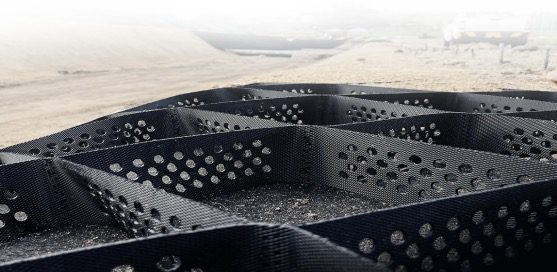
Geocells are honeycomb structures manufactured from high-density polyethylene (HDPE) or other polymeric alloys. Expanded on site, the cells form a flexible, permeable mattress that confines infill such as soil, aggregate, or concrete. Confinement raises the infill’s shear strength and forms a stable composite mass. The interconnected cells distribute vertical loads over a broader area, lowering stress on the subgrade. This mechanism helps avoid localized failures and supports overall slope integrity.
Key Benefits of Geocell Systems for Slope Stability
Geocell systems deliver notable advantages over traditional stabilization approaches. They control erosion by holding soil particles within the cells, even on steep grades. Their flexibility lets them adapt to irregular surfaces and simplifies installation. They also support vegetation growth and blend naturally with surrounding landscapes. The table below compares geocell benefits with conventional methods.
| Feature | Geocell Systems | Traditional Methods (e.g., Riprap, Concrete) |
|---|---|---|
| Erosion Control | Excellent, confines soil, promotes vegetation | Good, but can be less aesthetically pleasing |
| Cost-Effectiveness | Often lower material and installation costs | Can be high due to material volume and labor |
| Environmental Impact | Low, promotes natural aesthetics, permeable | Higher, can disrupt natural habitats |
| Installation Speed | Faster, less heavy equipment required | Slower, requires significant machinery |
| Flexibility | High, conforms to terrain | Low, rigid structures |
Diverse Applications of Geocells in Slope Protection
Geocells adapt well to varied site conditions across civil and environmental projects. Their ability to stabilize multiple infill types opens up a wide application range. We have implemented geocell solutions in demanding environments around the world with consistent results.
Steep Slope and Embankment Stabilization
On steep slopes and embankments, geocells provide needed reinforcement that limits mass movement and surface erosion. Common uses include road construction, railway embankments, and retaining wall systems. Cellular confinement enables the use of local infill, trimming haul costs and environmental impact. For example, HDPE Uniaxial Geogrid can provide slope stabilization for retaining wall systems. The system effectively resists shear forces and enhances the overall stability of the structure.
Erosion Control and Vegetated Slope Reinforcement
For long-term erosion control, especially where runoff is persistent, geocells protect the soil surface from hydraulic forces while supporting healthy vegetation within the confined infill. The result is a green, stable surface that integrates with the natural setting. We apply geocells in channel linings, storm water detention basins, and landfill covers to achieve durable, low-impact erosion management.
Designing and Installing Geocell Slope Reinforcement Systems
Strong geocell performance starts with careful design and disciplined installation. We support projects from early assessment through delivery and closeout to help ensure durable, predictable outcomes.
Site Assessment and Material Selection Considerations
A thorough site assessment anchors the design. This includes soil characterization, slope geometry, hydrology, and expected loading. With that data, we select geocell type, cell size, and depth. For example, geocells are manufactured from high-density polyethylene resin. These materials offer excellent resistance to environmental stress cracking, low temperature resistance, anti-aging, and corrosion resistance. Infill selection is equally important, ranging from granular soils to concrete as project needs dictate.
Installation Best Practices for Optimal Performance
Proper installation is paramount for the long-term success of a geocell system.
- Prepare the subgrade by clearing debris and compacting the surface.
- Anchor the geocell panels at the crest of the slope using stakes or anchors.
- Expand the geocell panels across the slope, ensuring full contact with the subgrade.
- Secure adjacent panels using connectors or stapling.
- Fill the cells with the specified infill material, typically in lifts, and compact each lift.
- Ensure adequate infill depth above the geocell to protect the system.
Following these steps ensures the geocell system functions as designed, providing robust slope stability.
Case Studies and Real-World Successes
The performance of our geocell projects speaks to the value of methodical design, sound materials, and consistent execution. The examples below reflect the technology’s range and reliability, backed by ongoing support and attention to detail.
1. Successful Slope Stabilization Projects Globally
We have contributed to numerous projects requiring advanced slope stabilization. From reinforcing railway embankments in challenging mountainous regions to stabilizing coastal defenses against erosion, geocells have proven their reliability. These projects showcase the adaptability of geocell technology to diverse geographical and environmental conditions. Our expertise ensures that each solution is tailored to the specific demands of the site.
2. Long-Term Performance and Environmental Benefits
The long-term performance of geocell systems is a key advantage. When properly installed, these systems maintain their structural integrity for decades, often exceeding the design life of traditional methods. They also offer significant environmental benefits, promoting natural vegetation and reducing the carbon footprint associated with heavy construction materials. This sustainable approach aligns with modern infrastructure development goals.
Frequently Asked Questions
What is the lifespan of a geocell slope reinforcement system?
Geocell systems, when properly designed and installed with high-quality materials like those from Feicheng Lianyi, can have a design life exceeding 50 years. Factors such as material type (HDPE), environmental conditions, and proper drainage significantly influence longevity. Our products are engineered for maximum durability and resistance to environmental degradation.
Can geocells be used in all soil types for slope reinforcement?
Geocells are highly versatile and effective across a wide range of soil types, from granular to cohesive soils. Their cellular confinement system enhances the shear strength and bearing capacity of infill materials, making them suitable for challenging soil conditions. Proper geotechnical assessment is crucial to determine the optimal geocell specifications and infill material for specific soil types.
Are geocell systems environmentally friendly?
Yes, geocell systems are considered an environmentally friendly solution for slope reinforcement and erosion control. They promote natural vegetation growth, reduce the need for hard armor solutions, minimize soil disturbance, and often utilize recycled or locally sourced infill materials. This contributes to sustainable infrastructure development and ecological restoration.
How do geocells compare to traditional slope reinforcement methods?
Geocells offer several advantages over traditional methods like riprap, concrete, or gabions. They are typically more cost-effective, easier and faster to install, require less heavy machinery, and provide superior erosion control by confining infill and promoting vegetation. They also offer greater flexibility in design and better aesthetic integration with the natural landscape.
Partner with Lianyi for Advanced Geosynthetic Solutions
Ready to secure your slopes with advanced geocell technology? Feicheng Lianyi Engineering Plastics Co.,Ltd offers world-class geocell solutions backed by unparalleled expertise and customer service. Our certified products (ISO 9001:2015, ISO 14001:2015, OHOAS 18001:2007, BV, SGS, TRI) ensure superior performance and durability for your most challenging projects. Contact us today for a consultation or to request a quote. Let us provide you with a one-stop geosynthetics solution tailored to your specific needs. Email: [email protected] | Mobile: +86 19153868161.