Call us today!

Selecting the right slope stabilization method makes a noticeable difference to service life and environmental outcomes. From experience, geocell technology has proven both robust and adaptable on tough terrain. Here we cover how geocells work, where they shine, and what it takes to design and install them well. The aim is practical detail for engineers and project managers who need reliable slope reinforcement.
Understanding Geocell Technology for Slopes
Geocell systems are a practical way to stabilize slopes, curb erosion, and improve load distribution. These three-dimensional cellular confinement systems turn unstable ground into a stable, vegetated surface. In demanding environments, they have held up consistently. The cellular structure forms a flexible, permeable mattress that elevates soil shear strength and resists movement.
1. What is a Geocell System?
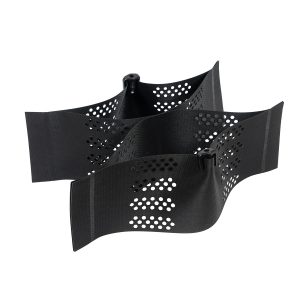
A geocell system is made of interconnected, expandable polymeric strips that form a three-dimensional honeycomb. The cells are usually manufactured from high-density polyethylene (HDPE) and shipped in a collapsed, compact form for easy transport. Once expanded on-site, they are filled with infill such as soil, aggregate, concrete, or sand. The cell walls confine the infill, limiting lateral movement and forming a stable composite layer. This confinement enhances the engineering properties of the infill material, enabling solid performance even on steep slopes.
2. How Geocells Stabilize Slopes
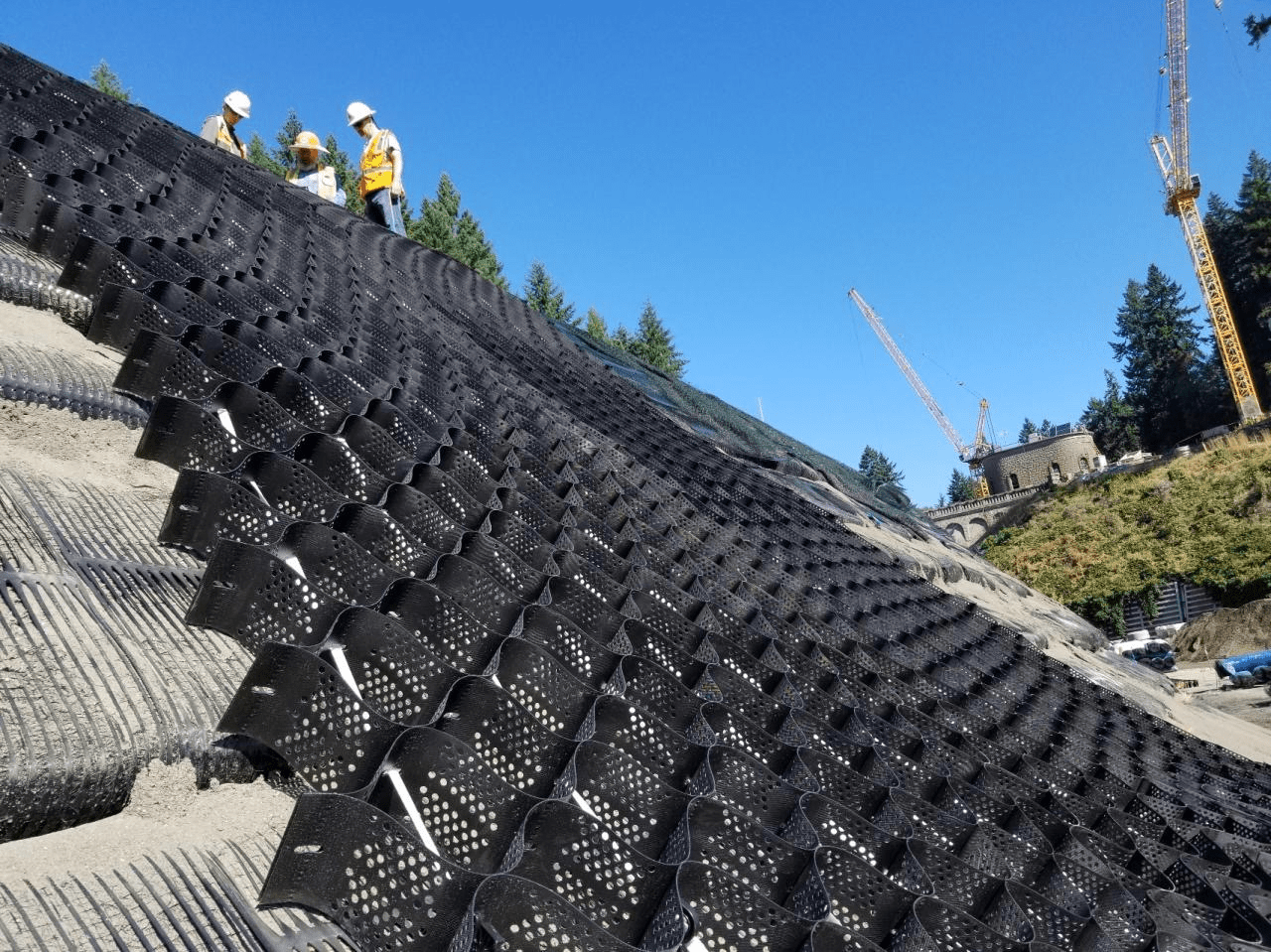
Geocells stabilize slopes by confining the infill within their cellular matrix, which restricts particle movement and controls erosion. Confinement increases the shear strength of the infill, building a more stable composite layer. The system spreads loads over a wider area, cutting localized stress points and guarding against deep-seated failures. Textured or perforated cell walls increase friction between the geocell and infill, adding stability. The interconnected cells behave like a flexible mat, resisting surficial erosion and mass movement, which suits challenging geotechnical conditions.
Diverse Geocell Applications in Slope Reinforcement
Geocells adapt well across a wide range of slope reinforcement needs. Their flexibility suits projects from critical infrastructure protection to environmental restoration. We utilize geocells to address diverse geotechnical issues effectively.
For example, in roadway and railway embankments, HDPE Geocell and Plastic Geocell systems prevent erosion and maintain structural integrity. The cellular confinement resists hydrostatic pressures and dynamic loads, ensuring long-term stability. In retaining wall systems, geocells create a stable, vegetated face, reducing construction costs and enhancing aesthetic appeal. They are particularly effective in areas prone to seismic activity or significant rainfall.
We also deploy geocells for channel and shoreline protection, where they resist scour and wave action. The confined infill, often concrete or aggregate, provides a durable and flexible armor layer that adapts to fluctuating water levels. Additionally, geocells are crucial in landfill lining systems, protecting geomembranes from puncture and providing stable support for cover soils. Their use ensures the long-term containment of waste materials.
In mining and industrial sites, geocells stabilize steep slopes created during excavation or waste disposal. They prevent material migration and allow for effective revegetation, minimizing environmental impact. For aesthetic and environmental purposes, geocells facilitate vegetated slope protection. They create a favorable microclimate for plant growth, even on harsh slopes, promoting biodiversity and natural drainage. This approach reduces runoff velocity and filters pollutants, contributing to healthier ecosystems.
| Application Area | Primary Benefit | Infill Material Examples | Typical Slope Angle Range |
|---|---|---|---|
| Roadway Embankments | Erosion control, load distribution | Granular soil, aggregate | Up to 1:1 (45°) |
| Retaining Walls | Vegetated fascia, structural stability | Vegetated soil, concrete | Vertical to 1:1 |
| Channel Protection | Scour resistance, flow velocity reduction | Aggregate, concrete | Varies with flow |
| Landfill Slope Stabilization | Erosion prevention, geomembrane protection | Vegetated soil, drainage aggregate | Up to 1:1.5 (34°) |
| Mining & Industrial Slopes | Material containment, revegetation support | Waste rock, local soil | Up to 1:1 |
Geocell Installation and Design Considerations
Good outcomes come from sound design and careful installation. Our expertise keeps each project aligned with those fundamentals.
Installation usually starts with site preparation, grading the slope to the target profile and compacting the subgrade. A geotextile separation layer is often placed to prevent infill contamination and improve drainage. Geocell sections are then expanded and anchored with stakes or pins, set to the right alignment and tension. Infill is placed and compacted within the cells, often in lifts, to reach the specified density. For vegetated slopes, a topsoil layer may follow, then seeding or planting.
Design turns on several factors. Select geocell type, cell depth, and aperture size based on slope angle, soil properties, and expected loads. Infill choice matters; cohesive soils work for vegetated slopes, while aggregates or concrete increase structural capacity. Drainage is a key element. Effective subsurface and surface drainage prevent water build-up that can weaken slope stability. We also weigh environmental conditions such as climate, rainfall intensity, and freeze-thaw cycles, which influence materials and detailing.
When considering various geosynthetic solutions for your project, understanding the characteristics of different materials is crucial. For further insights into barrier materials, you might find our discussion on 《The Difference Of Geomembrane And Composite Geomembrane》 particularly useful.
Why Choose Lianyi Geocells for Your Projects
Feicheng Lianyi Engineering Plastics Co.,Ltd is a world-class leader in geosynthetics, specializing in innovative geocell products for diverse engineering challenges. We offer a comprehensive range of solutions, backed by unparalleled expertise and customer service. Our commitment to quality is evident in every product we manufacture.
We develop and supply advanced geocell systems designed for superior performance in slope reinforcement, erosion control, and load support applications. Our geocells are engineered from high-quality, durable materials, ensuring long-term stability and resistance to environmental degradation. We provide tailored solutions to meet the specific demands of each project, from material selection to technical support. Our products undergo rigorous testing and adhere to international standards, guaranteeing reliability and effectiveness.
Lianyi has established a robust quality management system, holding ISO 9001:2015, ISO 14001:2015, and OHSAS 18001:2007 certificates. We also possess certifications from BV, SGS, and TRI, underscoring our dedication to superior products and ethical practices. Our one-stop geosynthetics solution approach ensures that clients receive comprehensive support throughout their project lifecycle. We are committed to delivering innovative, high-performance geocell technology that provides lasting value and secures infrastructure worldwide.

Call to Action
Ready to secure your slopes with world-class geocell technology? Contact Feicheng Lianyi Engineering Plastics Co.,Ltd today for expert consultation, product specifications, or to request a quote. Our team is dedicated to providing tailored geosynthetic solutions that meet your project’s unique demands. Email us at [email protected] or call +86 19153868161.
FAQs
1. How long do geocell systems last on slopes?
Lianyi geocell systems, when properly installed and maintained with appropriate infill, are designed for long-term performance, often exceeding 50 years. Their durability is enhanced by the high-quality, UV-stabilized polymeric materials used in manufacturing, ensuring resistance to environmental degradation.
2. Can geocells be used on very steep slopes?
Yes, geocells are highly effective for stabilizing very steep slopes where traditional methods might fail. The cellular confinement system provides excellent shear resistance and allows for the establishment of vegetation, even on inclines up to 1:1 (45 degrees) or steeper, depending on soil conditions and design.
3. What are the environmental benefits of using geocells for slope reinforcement?
Geocells offer significant environmental advantages by promoting natural vegetation growth, reducing stormwater runoff and erosion, and minimizing the need for hard armor solutions. They contribute to green infrastructure, improve biodiversity, and often utilize recycled or locally sourced infill materials, reducing carbon footprint.