Call us today!

Picking the right geotextile can feel like a judgment call that haunts you later if you get it wrong. Nonwoven or woven? The answer shapes everything from drainage performance to how long that road actually holds up under traffic. After working through countless project specifications, the distinction comes down to what you’re asking the fabric to do. This breakdown covers the real differences in how these materials behave, where each one belongs, and how to match them to actual site conditions.
What Makes Nonwoven Geotextiles Work
Nonwoven geotextiles start as synthetic fibers, usually polypropylene or polyester, laid down in random orientations and then locked together through needle punching, heat bonding, or chemical treatment. The result has that felt-like quality you notice immediately when handling it. Because the fibers run every direction, the fabric behaves the same way regardless of how you orient it during installation. Strength and water flow characteristics stay consistent whether you’re measuring lengthwise or across the roll.
Where nonwoven really earns its place is anywhere you need water moving through while keeping soil particles in place. That random fiber structure creates plenty of void space for flow, but the tortuous path filters out fines before they can migrate and cause problems. Subsurface drainage systems depend on this. Landfill projects use nonwoven as a cushion layer because it absorbs puncture forces that would otherwise compromise the geomembrane underneath.
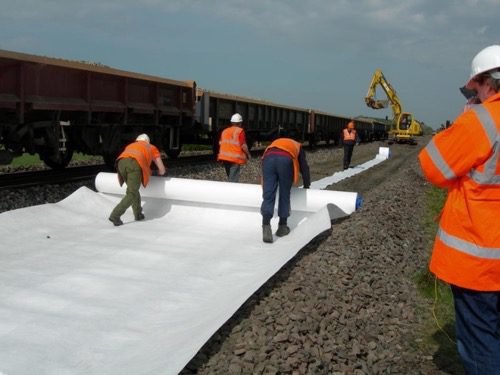
Nonwoven Geotextile Key Specifications
| Property | Description | Typical Range (Nonwoven) |
|---|---|---|
| Permeability | High flow rate, excellent filtration | 0.01-0.1 cm/sec |
| Puncture Strength | High, protecting membranes | 500-1500 N |
| Elongation | High, accommodating differential settlement | >50% |
| Applications | Filtration, separation, drainage, protection, erosion control | Varied |
How Woven Geotextiles Differ in Structure and Function
Woven geotextiles come off a loom. Individual yarns, again typically polypropylene or polyester, interlace in a regular pattern that creates dimensional stability you can feel when you pull on the material. It resists stretching. That low elongation combined with high tensile strength makes woven the go-to choice when you need the fabric to carry load or hold something in place.
Road base reinforcement is the classic application. The fabric spreads wheel loads across a wider footprint, reducing stress concentrations that would otherwise punch through into soft subgrade. Railway embankments, retaining wall reinforcement, anywhere structural performance matters more than water transmission, woven geotextiles handle the job. The tight weave also resists tearing and bursting forces that would shred a nonwoven under the same conditions.
Woven Geotextile Key Specifications
| Property | Description | Typical Range (Woven) |
|---|---|---|
| Tensile Strength | High, for reinforcement and stabilization | 50-1000 kN/m |
| Elongation | Low, providing structural stability | <25% |
| Modulus | High, resisting deformation | High |
| Applications | Reinforcement, separation (heavy-duty), subgrade stabilization, erosion | Varied |
Strength Versus Flow Rate and Why Both Matter
The manufacturing process creates two fundamentally different materials, and understanding where each excels prevents costly mismatches between product and application.
When Tensile Strength Drives the Decision
Woven geotextiles pull ahead dramatically on tensile strength. That interlocking yarn structure transfers load efficiently from fiber to fiber. PP Woven Geotextile products routinely deliver tensile strengths from 50 kN/m up past 1000 kN/m for heavy-duty grades. Nonwoven materials, with fibers pointing every which way, simply cannot match that load-carrying capacity. They stretch more before failing, which helps in some applications but works against you when you need the fabric to resist deformation under sustained load.
For road bases, retaining structures, or any application where the geotextile functions as a structural element, woven is the only reasonable choice.
When Permeability Takes Priority
Flip the requirements around and nonwoven wins just as decisively. The random fiber arrangement creates a more open structure with higher void ratio. Water passes through readily while fine soil particles get trapped in the matrix. Woven fabrics, with their tighter, more organized weave pattern, restrict flow. Some woven products are engineered for filtration, but their primary value lies elsewhere.
Drainage systems, french drains, filtration applications, anywhere you need drainage composite effectiveness, nonwoven geotextiles typically perform better.
Comparison Chart: Nonwoven vs Woven Performance Metrics
| Feature | Nonwoven Geotextile | Woven Geotextile |
|---|---|---|
| Primary Function | Filtration, separation, drainage, protection | Reinforcement, stabilization, heavy-duty separation |
| Tensile Strength | Moderate to Low | High to Very High |
| Elongation | High | Low |
| Permeability | High (excellent for drainage) | Low to Moderate (less ideal for drainage) |
| Puncture Resistance | High | Moderate |
| Cost | Generally lower per unit area for basic grades | Can be higher due to specialized strength requirements |
Matching Geotextile Type to Project Requirements
The right geotextile depends entirely on what the project actually demands. Soil conditions, hydraulic requirements, anticipated loads, all of these factor into the selection. Feicheng Lianyi Engineering Plastics Co.,Ltd works through these variables with engineers to identify the most appropriate product for each situation.
Road Construction and Subgrade Stabilization
Road projects often use both types in combination. Woven geotextiles handle the reinforcement function, distributing wheel loads and preventing rutting. Their high tensile strength keeps the base course stable under repeated traffic loading. Fiberglass Geogrids or PP Biaxial Geogrid can supplement or replace woven geotextile in the structural role depending on design requirements.
Nonwoven geotextiles serve as separation layers between aggregate and soft subgrade soils. They prevent intermixing that would compromise base course integrity while allowing drainage to prevent pore pressure buildup. Using both types where conditions warrant optimizes overall pavement performance.
If you’re interested in understanding the foundational differences between geomembranes and composite geomembranes, we recommend reading 《The Difference Of Geomembrane And Composite Geomembrane》.
How Manufacturing Shapes Performance
The production method determines what each geotextile type can and cannot do. Understanding these processes explains why certain applications favor one type over the other.
Production Techniques and Their Consequences
Needle punching drives barbed needles repeatedly through a fiber batt, mechanically interlocking the fibers into a coherent fabric. The result is strong, permeable, and accommodating of deformation. Thermal bonding uses heat to fuse fibers at contact points, producing a stiffer material with different handling characteristics.
Woven production follows traditional textile manufacturing principles. Individual yarns pass over and under each other in a controlled pattern, creating a fabric with predictable, directional properties. The weave pattern, yarn denier, and yarn count all influence final performance characteristics.
Polymer selection matters too. Polypropylene costs less and resists most chemicals well. Polyester offers higher strength and better UV stability but at higher cost. The specific manufacturing parameters, combined with raw material choices, determine hydraulic properties, tensile strength, elongation behavior, and long-term durability.
Feicheng Lianyi Engineering Plastics Co Ltd Geosynthetic Solutions
Feicheng Lianyi Engineering Plastics Co.,Ltd manufactures geosynthetics for civil engineering applications worldwide. The product line includes geogrids, geotextiles, geomembranes, and geocells covering the full range of ground improvement and containment applications. Quality certifications include ISO 9001:2015, ISO 14001:2015, OHSAS 18001:2007, along with BV, SGS, and TRI verification. Technical support extends from product selection through installation guidance.
Lianyi Geosynthetic Product Range
| Product Category | Key Products |
|---|---|
| Geotextiles | Nonwoven geotextiles (needle-punched, thermal bonded), Woven geotextiles (PP, PET) |
| Geogrids | Fiberglass geogrids, PP biaxial geogrids, uniaxial geogrids, polyester geogrids |
| Geomembranes | HDPE geomembranes, LDPE geomembranes, composite geomembranes |
| Geocells | HDPE geocells for slope protection, load support, channel lining |