Call us today!

Highway embankments are critical infrastructure components, yet they frequently face stability challenges from various environmental and geotechnical factors. We understand these issues directly impact road safety and longevity. Our experience shows that addressing these highway stability issues requires robust engineering solutions. This article explores how geocell technology provides effective and sustainable reinforcement for highway embankments, mitigating common failure mechanisms and enhancing overall structural integrity.
Understanding Highway Embankment Challenges and Geocell Fundamentals
Highway embankments are susceptible to several failure modes, primarily driven by inherent soil properties and external forces. Common highway stability issues include excessive settlement, shear failure, and severe soil erosion prevention. These problems often stem from embankment design flaws, inadequate compaction, or the presence of soft, compressible soils. For instance, heavy rainfall can lead to pore water pressure buildup, reducing soil strength and increasing the risk of slope instability.
Geocell technology offers a proven solution to these challenges. A geocell structure is a three-dimensional cellular confinement system, typically made from high-density polyethylene (HDPE) strips. These strips are ultrasonically welded to form a honeycomb-like matrix. When filled with granular material, the cellular confinement system creates a stiff, mattress-like structure that effectively distributes loads over a wider area. This confinement significantly increases the shear strength of the infill material, preventing lateral movement and enhancing bearing capacity.
Strategic Design Principles for Geocell Reinforced Embankments
Effective geocell reinforcement requires adherence to strategic geocell design principles. Engineers must consider the specific site conditions, including soil type, groundwater levels, and expected traffic loads. The selection of geocell material specifications and dimensions, such as cell height and aperture size, directly influences the system’s performance. For instance, deeper cells provide greater confinement and are suitable for higher loads or softer subgrades.
Proper infill material is also critical; well-graded granular soils or even recycled aggregates can be used. The design must also account for drainage requirements to prevent water accumulation within the geocell structure. Our experience with geosynthetic cellular confinement solutions demonstrates that meticulous planning ensures optimal slope stabilization geocell performance. These systems excel at load distribution geocell applications, significantly improving the overall stability of the embankment.
If you are interested in how different geosynthetic materials are used, check out 《The Difference Of Geomembrane And Composite Geomembrane》.
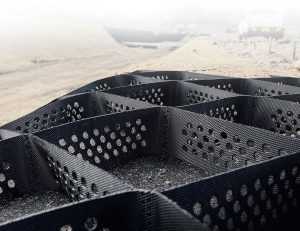
Advanced Geocell Applications in Highway Embankment Construction
Geocells demonstrate versatility in various highway embankment construction scenarios, offering advanced solutions beyond conventional methods. For steep slope geocell reinforcement, geocells provide critical confinement, allowing for steeper and more stable slopes than unreinforced earth. This is particularly beneficial in areas with limited right-of-way.
For soft soil stabilization, HDPE Geocell systems effectively bridge weak subgrades, reducing differential settlement and increasing bearing capacity. This capability minimizes the need for extensive excavation and replacement of unsuitable soils. Geocells also excel in erosion control geocell applications, protecting embankment surfaces from scour and promoting vegetated geocell slopes. This approach combines structural stability with environmental benefits.
| Feature | Geocell Reinforcement | Traditional Embankment Reinforcement |
|---|---|---|
| Slope Angle | Steeper (up to 1:1) | Flatter (1.5:1 to 2:1) |
| Material Usage | Reduced aggregate volume | High aggregate volume |
| Erosion Control | Excellent, promotes vegetation | Often requires separate measures |
| Load Distribution | Superior, cellular confinement | Dependent on soil compaction |
| Construction Speed | Faster installation | Can be slower, more earthwork |
| Maintenance Needs | Lower long-term maintenance | Higher, especially for erosion |
Long Term Performance and Lifecycle Benefits of Geocell Systems
The long-term performance of geocell systems is a significant advantage in highway infrastructure. Geocell durability is high, as the HDPE material resists degradation from environmental factors, chemicals, and UV radiation. This inherent resilience contributes to a sustainable infrastructure. The cellular confinement system maintains its integrity over decades, ensuring continuous support for the embankment.
We observe that geocell-reinforced embankments exhibit reduced maintenance road requirements over their lifecycle. This translates into substantial lifecycle cost geocell savings compared to conventional construction methods. Furthermore, the environmental benefits geocell systems provide are considerable. They minimize the carbon footprint by reducing aggregate transport and promoting natural vegetation, aligning with modern sustainable infrastructure goals. These benefits underscore the strategic value of integrating geocells into highway projects.
Implementing Geocell Solutions with Feicheng Lianyi Expertise
Feicheng Lianyi Engineering Plastics Co.,Ltd. provides world-class geocell solutions for diverse engineering challenges. We specialize in developing innovative geosynthetic products, including our robust Lianyi geocell products. Our extensive product range also encompasses geogrid, geotextile, geocomposite, and geomembrane materials, offering comprehensive geosynthetic solutions provider capabilities.
We hold ISO 9001:2015, ISO 14001:2015, and OHSAS 18001:2007 certifications, alongside BV, SGS, and TRI accreditations, affirming our commitment to quality. Our custom geocell engineering services ensure tailored solutions that meet specific project requirements. As a leading geosynthetic supplier China, we deliver superior products backed by unparalleled expertise and customer service.

Frequently Asked Questions
How do geocells enhance long term stability of highway embankments?
Geocells enhance long-term stability by creating a three-dimensional cellular confinement system that restricts lateral movement of fill material, distributes loads over a wider area, and prevents erosion. This significantly improves the shear strength of the soil, reduces settlement, and maintains the structural integrity of the highway embankment over time.
What are the critical design considerations for geocell reinforced slopes?
Critical design considerations for geocell reinforced slopes include soil type and properties, slope angle, expected loads, drainage requirements, and environmental factors. Proper geocell selection (cell size, depth, material type), infill material, and anchorage systems are crucial for effective highway embankment reinforcement.
What are the environmental and cost benefits of using geocells in road construction?
Geocells offer significant environmental benefits by reducing the need for aggregate materials, minimizing excavation, and promoting vegetation growth for erosion control. Cost benefits include reduced material transport, faster construction times, lower long-term maintenance, and enhanced durability of the highway infrastructure.
Partner with Feicheng Lianyi for Advanced Geosynthetic Solutions
Elevate your highway infrastructure projects with unparalleled stability and longevity. Contact Feicheng Lianyi Engineering Plastics Co.,Ltd. today for expert consultation and world-class geocell solutions tailored to your specific engineering challenges. Partner with us for reliable, innovative, and certified geosynthetic materials that build the future. Email us at [email protected] or call +86 19153868161.